Thursday, 14 May 2015
The number thinking, idea made more simple thinking,...
The number thinking, idea made more simple thinking, is a part of number thinking that has in it the human made ideas of: move happen caused by other move happen expression, adding of very many very small things which are not totally known, ways to say how much of something there is when you have not all of it but some weird part, where slower and slower things end up after a very long time, what things will do after a very long time when you are adding them, and facts about the relationships which we use to match parts of the real and imagined space which can be thought of as very very soft to touch even when you look really close and in weird ways.
This is the first line from 'Mathematical' 'analysis' on 'wikipedia'.
And the quotes are so I can show you this.
Normally it reads:
Mathematical analysis is a branch of mathematics that includes the theories of differentiation, integration, measure, limits, infinite series, and analytic functions.
My 'translation' was made using this tool, made by @TheoSanderson. The idea of constraint to a smaller vocabulary is an interesting one, and I think potentially very powerful. Mr Munroe has used it to create a comic strip and now a book, but I think it could also be used for teaching and learning, comedy, not to mention generally making text more accessible.
I also think it could have a place in games and puzzles. Everyday language is so well suited to what we use it for that we rarely get to play around with being constrained in general communication. The closest most people get is probably trying to order lunch in a foreign city. Don't you find there's something fun about thinking about how to translate complicated ideas into simple language? Have a play on the website above. I think it's great.
Or should that be: Don't you find there's something fun about thinking about how to word-change from not-easy-to-think-of ideas into simple groups of words? Have a play with the phone-line-using-word-show-picture above. I think it's great.

Monday, 11 May 2015
The 5th Element
While it's still interesting...
It's been known for a while that ITV's The Chase is looking
to cast a 5th chaser. The Chase is arguably ITV's best quiz currently running,
and often challenges Pointless for the highest daytime ratings each week. A
large part of The Chase (and Pointless)'s appeal come from their casts, and so
the identity of the 5th chaser is of big significance to both shows.
This week Mark Labbett
tweeted a crucial hint to the 5th chaser's identity. It's been suggested
before that the 5th chaser will be a young(er than the other chasers) woman, codenamed
'The Vixen'. Mark says: "the vixen is a champion of TVs toughest quiz".
That seems like it should be enough information to prepare a shortlist, and in doing so, quietly celebrate some of the UK's best female TV quizzers.
 |
| I've no idea who @bothersbar is. |
Googling TVs toughest quiz, yields, on page 1, mentions of 4
UK quizzes: Who Wants to be a Millionaire, University Challenge, Only Connect,
and 15-to-1. For this consideration, I'd also like to throw in Mastermind,
which I doubt many would dispute is at least, a very tough TV quiz.
We start by eliminating the non-options. 15-to-1 has not
seen a non-celebrity female winner since Daphne Fowler in 2001. Daphne, whilst
she would make an amazing addition to the chase, recently retired from
Eggheads, so it seems unlikely she would wish to return to TV. Winners before 2001
are a possibility, but it seems a bit unlikely that a 'young' chaser would be
more than 15 years into a quizzing career.
Similarly, Who wants to be a millionaire(?). Only one of its
five UK champions is female, Judith Keppel, and she is also associated
currently with the spiritual rival BBC show, Eggheads.
Only Connect and UC, then, will throw up most of our
options, with Mastermind providing one outsider.
Three of the thirty (if the reader receives these figures
with a mild sense of dismay, they are in the same mindset as the author) Only
connect series champions have been women:
Series 3's Gamblers included Jenny
Ryan;
 |
| Prior to choosing a greek letter. |
Series 4's Epicureans were lead by Katie Bramall-Stainer,
 |
| Improvised Movie Lines |
and Series 6's
Scribes featured Holly Pattenden.
 |
| Songs to do with letter-writing. No, I didn't get it either. |
From what little this researcher could find of them while
compiling this list, all 3 are strong potential chasers, displaying impressive
knowledge (although, as OC champions of course they are). As her team's
captain, I saw a little more of Bramall-Stainer's character than Pattenden or Ryan,
and think she in particular, might have a good ability to play to the
half-friendly adversary role that The Chase demands.
Moving onto UC, unlike OC, for which lists of past champion players are not so readily available (for Institutions, yes, which I think tells
you more than a little about the strange way UC is viewed in society). However,
this researcher is reasonably familiar with the recent history of University
Challenge, and can identify two strong candidates who have been particularly
memorable UC winners (and in fact, winning captains).
More famous is Gail Trimble, who won (ish) with Manchester in
2009, and generated such enormous media coverage at the time that I'm not even
going to link it, go google if you need to. Gail's knowledge is perhaps the
most impressive of any on this list, and she certainly carries enough fame from
her UC time to 'need no introduction' if appearing on The Chase. However, from
her appearances on UC, I worry whether Gail's personality is too earnest, and
generally well-meaning to meet the character role required for the Chase. Trimble,
who is now Dr Trimble, is a fellow in Classics at Trinity College Oxford, and
has made few quiz or media appearances since 2009.

Compare to Daisy Christodoulou (easier to pronounce than
you're thinking), who was winning team captain for Warwick in 2007. A better historian
might give you arguments as to why Christodoulou's win was not followed by the
same sort of media explosion as Trimble's - but certainly it wasn't due to less
impressive general knowledge, as Christodoulou displayed incredible knowledge through
her series, including the most important skill for a UC winner, the ability to recall
information exceptionally quickly for the buzzer questions.

As a former secondary school teacher, I'm sure Christodoulou
has the toughness needed to appear on The Chase. Christodoulou has also not
been media-shy since her victory; appearing in a 'graduates' series of UC, as
well as a short film about education for the daily politics.
Christodoulou is described by Wikipedia, first as an
education researcher. She has written a book, and given talks on the subject of
education. Perhaps this is not incompatible with a regular quiz-show
appearance?
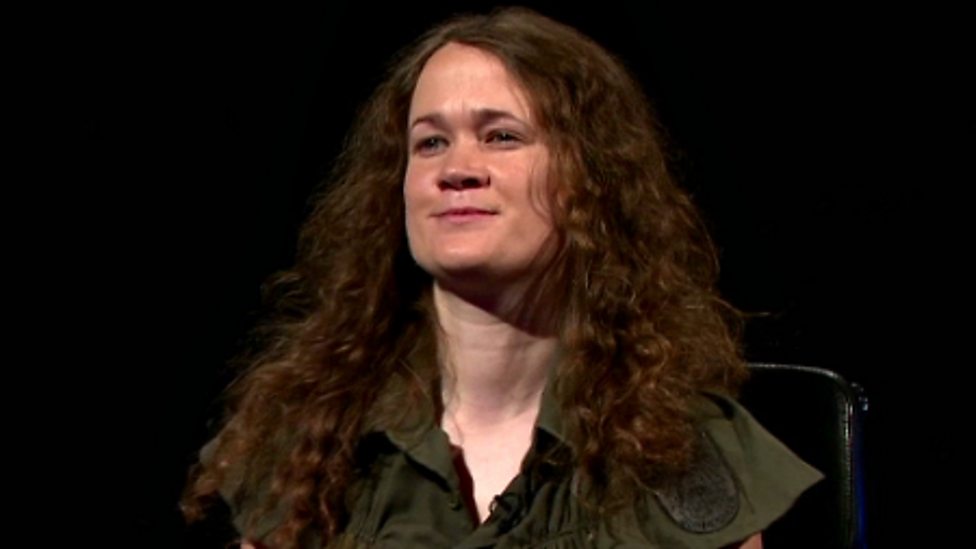
And finally, a relative outsider, 2015 mastermind champion Marianne
Fairthorne. I remember Fairthorne mostly for captaining the Festival Fans in
series something of Only Connect, you may or may not remember her mostly for
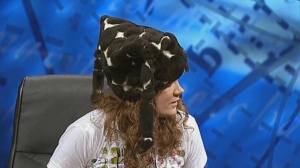
wearing a hat on University Challenge. She is a relatively recently active TV-quizzer,
having only won mastermind this year, but is again a great character who I
think could 'work' on The Chase.
 | |
| It felt necessary to mention the hat. |
 |
| Appearing on Mastermind |
So there you have it. I'm sure in a few days or weeks this
speculation will be rendered entirely wrong, but for now, my analysis of the
potential 5th Chasers for ITV.
Thursday, 9 April 2015
Talos and Story in Puzzles
I want to rave a bit about The Talos Principle.
Steam tells me I've played 5 hours and I feel like I'm
barely scratching the surface (although I play quite slowly and methodically).
It's probably been reviewed properly enough times by now, so I won't, but I
will summarise by saying that in my opinion it offers the rarely-seen
combination of excellently designed puzzles; rich, beautiful artwork, and an immersive
story and universe.
 |
| Confusing, weird, and very pretty. |
Last night I was stuck for around 40 minutes on one of the
star puzzles. I had searched everything on this island twice and was feeling
utterly, utterly defeated at the hands of this (as it turned out not too
difficult) puzzle. My attempts: initially systematic, then frantic, had become
completely random and I was close to losing all hope. Just then, at what felt
like the last second, I spotted the trick I was looking for and within 20
seconds had the puzzle complete.
My head fell into my hands and I spent a good 30 seconds
just breathing and clearing my thoughts. A real sense of desperation, and genuine
stress had crept into me attempting this not-roadblocking, not-time-pressured,
not-mentally intensive puzzle. I needed to calm down. I needed to recover. It
was a very unusual, but deeply satisfying experience.
There are two points about this anecdote I want to
emphasise.
 |
| Pretty pretty pretty. |
First is that The Talos Principle featues excellently
designed puzzles. Although IMO the difficulty skews a little toward too easy
throughout the game overall (caveat: I'm only about 20% of the way through),
there are difficult ones out there (generally the stars, which don't seem essential for progress at my stage
in the game), and all of the puzzles are incredibly elegant. It is actually
very hard, and requires a lot of time and energy, to get stuck in the Talos
Principle, because even if you can't see what works, you can usually see a few
things that might work, and
experimentation has a lovely tendency to reveal something you didn't think of
yet.
Second is that I experienced a well known puzzle-feeling,
the: I have exhausted everything I could
try, I have no hope of proceeding, I may
as well consult a walkthrough now manner. But I didn't, and I didn't ever
feel close to doing so, not because I was worried about spoiling the puzzle,
but because TTP had me so thoroughly
wrapped up in its world that I didn't want to break out of character by
minimising the game. It would have
felt **awful** to do so. So I think this is a key lesson about the interaction
between game and story and puzzle: very often a quality of story can tide over
a temporary dissatisfaction due to a stuck puzzle.
Subscribe to:
Posts (Atom)